
Why Donut Browser Doesn't Collect Any Telemetry
Donut Browser collects no telemetry at all: no usage tracking, no analytics endpoints, no phone-home requests. Nothing about how you use the app leaves your machine, and because the entire codebase is open source, you can verify that yourself.
Most software collects some form of telemetry: usage metrics, feature engagement data, behavioral analytics. Even privacy-focused tools often justify collecting “anonymous” data to improve the product. Donut Browser ships with none of that. This is not an oversight. It is a deliberate choice, and here is why.
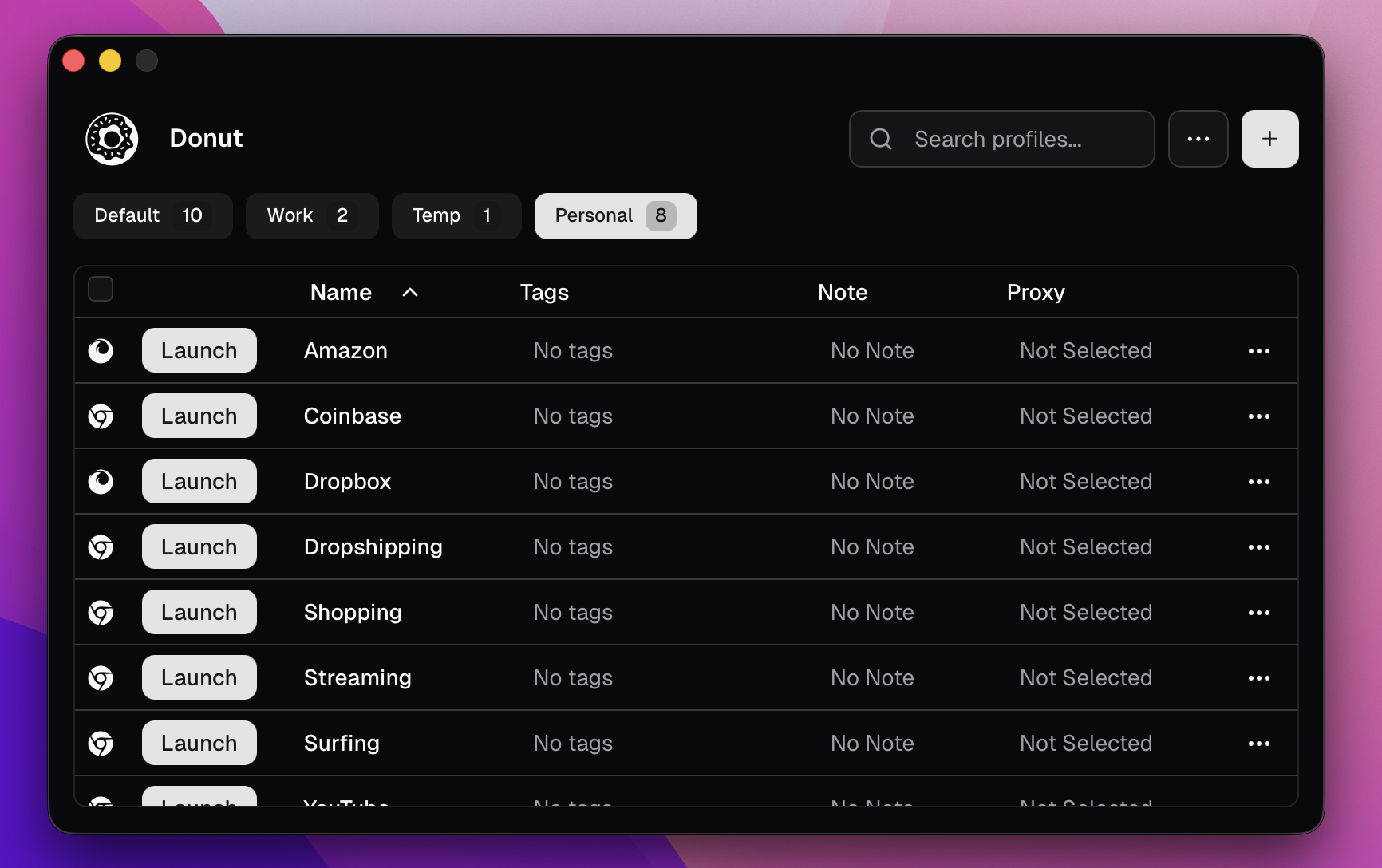
Why doesn’t Donut Browser collect any telemetry?
Donut Browser exists to give you control over what you share online. The entire product is built around the idea that websites should not be able to track you across profiles, link your identities, or collect data without your meaningful consent. A privacy tool that quietly sends your usage patterns back to a server, even “anonymized,” would undermine the very thing it promises to protect.
Some anti-detect browsers go even further in the wrong direction. Dolphin Anty, another anti-detect browser, generates a unique machine ID for every installation and uses it to track users even after they reinstall the app. This is the kind of practice that treats users as products rather than people, and it is fundamentally at odds with what privacy software should be.
Donut Browser was built to make privacy accessible to everyone, not just technically inclined users. That means the tool itself has to respect the same principles it enforces for the websites you visit.
How can you verify there is no telemetry in Donut Browser?
Donut Browser is fully open source under AGPL-3.0. The entire codebase is available on GitHub for anyone to inspect. If you want to verify that there is no telemetry, you can read the source code yourself.
Open source also creates a direct channel for bug reports and feature requests. If something breaks, users report it as a GitHub issue, and if it gets reported, it is an issue worth looking into. The report comes with steps to reproduce, system details, and often a conversation that leads to the root cause. A telemetry event that says “button clicked 47 times” tells you almost nothing useful by comparison.
How does Donut Browser catch bugs without usage data?
Quality comes from two safety nets, one before release and one after:
- Hundreds of unit and integration tests run on every change. Every commit goes through automated testing to verify that core functionality works correctly before it reaches users.
- An open issue tracker catches what slips through, reported by users who care enough to file an issue, with context that analytics can never provide.
This is a more reliable safety net than telemetry. Usage analytics might tell you that a feature is rarely used, but they will not tell you whether it works correctly. Tests will, and they do it before the code ships, not after users encounter the problem.
Do in-app analytics actually help build better software?
Rarely. Having worked in large enterprises where in-app analytics were treated as gospel, I can say from experience that the vast majority of product decisions that actually matter come from user interviews and direct feedback, not from dashboards showing how many times a button was clicked.
Analytics tools are good at telling you what happened. They are bad at telling you why. Knowing that 30% of users dropped off at step 3 of a flow is interesting, but it does not tell you whether the flow is confusing, slow, or simply unnecessary. A five-minute conversation with a user will.
For a project like Donut Browser, direct feedback through issues and conversations with users provides more actionable insight than any analytics dashboard. The features that matter most are the ones users ask for, not the ones suggested by a funnel chart.
Why should zero data collection be the default for software?
The web has normalized data collection to the point where most people assume every application is tracking them in some way. This is exactly the problem Donut Browser is trying to solve, not just for browsing, but by example.
If a privacy tool can function without telemetry, so can most software. The choice to not collect data is not a sacrifice. It is a statement that user trust matters more than vanity metrics, and that good software can be built without surveillance.
Donut Browser will continue to ship with zero telemetry. If you have feedback, open an issue or send an email to [email protected].
Frequently asked questions
Does Donut Browser collect any telemetry or usage data?
No. Donut Browser ships with zero telemetry: no usage tracking, no analytics endpoints, and no phone-home requests. Nothing about how you use the app leaves your machine.
How can you verify that Donut Browser has no telemetry?
Donut Browser is fully open source under AGPL-3.0. The entire codebase is on GitHub, so you can read the source code yourself and confirm there is no tracking.
How does Donut Browser find bugs without telemetry?
Hundreds of unit and integration tests run on every change, and users report problems directly as GitHub issues. Tests catch problems before release, and issue reports arrive with reproduction steps and system details that telemetry never provides.
Do other anti-detect browsers collect telemetry?
Many do. Dolphin Anty, for example, generates a unique machine ID for every installation and uses it to track users even after they reinstall the app.
Will Donut Browser ever add telemetry?
No. Donut Browser will continue to ship with zero telemetry. Feedback comes through GitHub issues and email instead.
